
Top Windiest Cities and Towns in Michigan
Michigan averages 30 days of thunderstorm activity annually. Tornadoes are all too common along the southern border, averaging 17 per year.
In this article, we’ll look specifically at average wind speed followed by thunderstorm wind speeds and their impact on your home.
Understanding these factors is vital, not just from a weather enthusiast’s perspective but also for homeowners concerned about the integrity of their property. We recognize the direct correlation between severe weather conditions and their potential risks to your home’s foundation. This knowledge is crucial in preparing for and mitigating the damages caused by these natural forces. By exploring these topics, we aim to provide insights and practical advice on protecting your home’s foundation from the adverse effects of high wind speeds and thunderstorms.
Windiest Cities and Towns in Michigan: Average Wind Speed
We’ve reviewed the average wind speed information at City-Data to find the top 20 cities in Michigan for the highest average wind speed. We’ve chosen only those cities with populations of 6,000 or more.
| # | City/Town | MPH |
| 1 | Norton Shores | 10.6 |
| 2 | Muskegon Heights | 10.6 |
| 3 | Grand Haven | 10.6 |
| 4 | Muskegon | 10.6 |
| 5 | Ludington | 10.4 |
| 6 | Allendale | 10.3 |
| 7 | Highland Park | 10.3 |
| 8 | Grosse Pointe Park | 10.3 |
| 9 | Huntington Woods | 10.3 |
| 10 | Detroit | 10.3 |
| 11 | Harper Woods | 10.3 |
| 12 | Fraser | 10.3 |
| 13 | Berkley | 10.3 |
| 14 | Grosse Pointe Farms | 10.3 |
| 15 | Center Line | 10.3 |
| 16 | Clawson | 10.3 |
| 17 | Mount Clemens | 10.3 |
| 18 | Ferndale | 10.3 |
| 19 | Grosse Pointe Woods | 10.3 |
| 20 | Oak Park | 10.3 |
Windiest Cities and Towns in Michigan: Thunderstorm Winds
Average wind speed can tell us quite a bit about local conditions, but thunderstorm winds can really show what can happen with high winds in Michigan.
We’ve reviewed NOAA’s National Centers for Environmental Information’s Storm Events Database. In the range of Nov. 1, 2019, to Nov. 30, 2020, they identified 68 places affected by thunderstorm winds.
Here are the top 20 ranked by recorded wind speed. Note that duplicate listings of the same town or same thunderstorm at a lower wind speed have been omitted from our ranking.
| # | City/Town | MPH |
| 1 | Forest Dunes, Van Buren County | 87 |
| 2 | Hisula, Houghton County | 83 |
| 3 | Pequaming, Baraga County | 83 |
| 4 | Zeba, Baraga County | 75 |
| 5 | Crystal Falls, Iron County | 74 |
| 6 | Ravenna, Muskegon County | 70 |
| 7 | Alston, Houghton County | 70 |
| 8 | Pelkie, Baraga County | 70 |
| 9 | Basswood, Iron County | 70 |
| 10 | Grandville Airport, Kent County | 65 |
| 11 | Ewen, Ontonagon County | 65 |
| 12 | Gibbs, Iron County | 65 |
| 13 | Baraga, Baraga County | 65 |
| 14 | Graafschap, Allegan County | 63 |
| 15 | Ypsilanti, Washtenaw County | 62 |
| 16 | Kellogg Airport, Calhoun County | 61 |
| 17 | Lanse, Baraga County | 61 |
| 18 | Gotts Corners, Huron County | 61 |
| 19 | Tri-City Airport, Saginaw County | 60 |
| 20 | Fawn River, St. Joseph County | 60 |
The top listed wind speed of 87 mph at Forest Dunes on June 26, 2020, caused $1 million in property damage across a wide area. The severe thunderstorm downburst brought down a number of trees as well as garages and outbuildings.
Property damage in Basswood on Aug. 9, 2020, amounted to $150,000 with at least 100 trees down, damaging homes around Golden Lake in Iron County.
Local Wind Statistics: Understanding the Impact in Michigan Cities
We’ve dug slightly deeper into the average storm winds for the locations in Michigan where we have offices.
Average winds in Grand Rapids are 9.8 mph. That’s down a bit from the top-ranked city at 10.6 mph. In Kent County, the storm on June 10, 2020, saw winds of 65 mph with $100,000 in property damage, as well as downed trees and power lines.
The Detroit area’s wind average is 10.3 mph. Wayne County saw winds of 55 mph during a thunderstorm on June 26, 2020. That brought down the usual trees and power lines.
Traverse City’s average is 8.7 mph. A thunderstorm on June 10, 2020, brought high winds up to 54 mph with trees down and flooding.
Impact on Your Home from Winds and Storms
The impact of wind on a home’s foundation is a critical yet often overlooked aspect of storm damage. High winds, particularly those accompanying thunderstorms, can cause significant structural strain.
When winds are strong enough, they can lead to soil displacement and erosion around the foundation, undermining its stability. Furthermore, wind-driven rain can exacerbate existing issues, such as cracks or weak points in the foundation, leading to water infiltration, mold growth, and further weakening of structural integrity. In areas like Michigan, where wind speeds can be particularly high, understanding and addressing these risks is essential for maintaining the longevity and safety of your home.
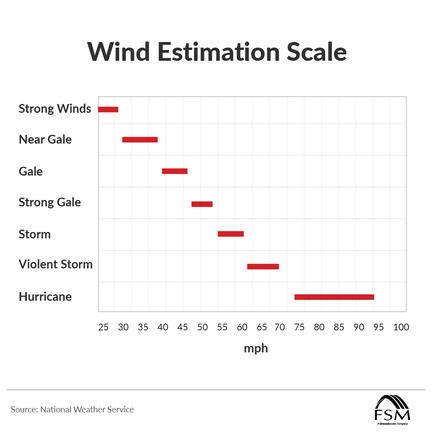
The National Weather Service has built a wind estimation scale designed to give observers a way to judge wind speed. Here are the details.
Consult Foundation Systems of Michigan
As you can tell, strong winds can do a great deal of damage to trees, utility lines, signs, and homes. Plus, the flying debris can cause still further damage. That’s been readily apparent with the thunderstorms throughout Michigan.
We’re hopeful that high winds won’t damage your home’s foundation. Even so, rainwater driven by wind can find its way into your basement or crawl space if there are any cracks or if the water accumulates around your home.
To ensure your home is fortified against these elements, we urge you to take a proactive step. Contact Foundation Systems of Michigan for a comprehensive, no-cost inspection and repair estimate. Our team of experts will meticulously assess your basement or crawl space, pinpointing any vulnerabilities that heavy rains and potential flooding could exacerbate. Protect your home now and secure your peace of mind by scheduling your free consultation today.
FAQs
Yes, uprooted trees and shifting roots can disturb the soil and impact your foundation’s stability.
An inspection can identify hidden damage and prevent minor issues from becoming major problems, ensuring your home’s safety and stability.
Look for visible cracks, uneven floors, water seepage, and other signs of structural distress.

Leah Leitow
Publish Date:
Last Modified Date:
Our Locations
32985 Schoolcraft Road
Livonia, MI 48150
5985 Clay Avenue SW
Grand Rapids, MI 49548
2817 Bond St.
Rochester Hills, MI 48309
5555 Airport Hwy
Toledo, OH 43615
3805 Elmers Industrial Drive
Traverse City, MI 49685